
Introduction: Legal Guidance for Global Startup Founders, Operators, and Investors
Are you a startup founder, operator, or investor with international ambitions? If your business is operating or raising capital across borders, you need an international startup lawyer to help you navigate the complex legal landscape. International expansion introduces complex legal, regulatory, and cultural challenges that require specialized legal counsel. An international startup lawyer helps new businesses navigate foreign regulations, protect intellectual property, and structure cross-border expansion. Hiring an international startup lawyer mitigates legal, regulatory, and cultural risks for entrepreneurs expanding globally.
Faison Law Group is a boutique transactional law firm based in Millersville, Maryland, representing startups and emerging companies across the United States—with deep experience serving founders in New York City, Boston, San Francisco, Southern California (including Los Angeles and San Diego), Maryland, Washington, DC, Northern Virginia, Austin, Philadelphia, and South Florida. The firm focuses on the unique challenges facing companies with international dimensions: foreign founders entering U.S. markets, domestic startups raising capital from overseas investors, and technology businesses navigating data privacy and compliance obligations that span multiple jurisdictions. The firm also advises clients on matters of commerce, including international trade and business regulation, ensuring compliance with the complex regulatory environment affecting cross-border transactions.
Why This Matters: International expansion introduces complex legal, regulatory, and cultural challenges that require specialized legal counsel. Without the right guidance, startups risk costly missteps, regulatory penalties, and missed opportunities in global markets.
What Is an International Startup Lawyer?
An international startup lawyer provides legal counsel to high-growth, venture-backed companies navigating operations, fundraising, and transactions that span more than one country. This includes helping new businesses navigate foreign regulations, protect intellectual property, and structure cross-border expansion. Hiring an international startup lawyer mitigates legal, regulatory, and cultural risks for entrepreneurs expanding globally.
Summary: Core Services and Value of an International Startup Lawyer
International startup lawyers coordinate a global legal framework to ensure businesses comply across multiple jurisdictions. Their core services and value include:
- Regulatory compliance: Adhering to international trade laws, data privacy, and local regulations in every market where you operate.
- Intellectual property protection: Securing patents, trademarks, and copyrights across multiple jurisdictions to safeguard your innovations.
- Cross-border structuring: Setting up subsidiaries, joint ventures, and choosing the right entity structure to manage liability and tax exposure.
- Contract drafting and negotiation: Ensuring commercial agreements, employment contracts, and vendor relationships are enforceable and compliant worldwide.
- Dispute resolution: Managing international arbitration and resolving disputes with foreign partners.
- Risk mitigation: Proactively identifying and addressing legal, regulatory, and cultural risks for global expansion.
What an International Startup Lawyer Actually Does
An international startup lawyer provides legal counsel to high-growth, venture-backed companies navigating operations, fundraising, and transactions that span more than one country. Unlike general corporate attorneys who focus primarily on domestic matters, this role requires deep experience coordinating legal strategy across multiple jurisdictions—often under time pressure and with significant capital at stake.
Key Scenarios for International Startups
- Foreign founders flipping into a Delaware C-corp. A technology company based in Europe, Canada, or Latin America restructures to create a U.S. holding company, typically Delaware, to attract venture capital investors or position for a U.S. exit.
- U.S. startups raising capital from foreign investors. Angel investors, family offices, or funds based abroad want to participate in your round. This triggers questions about securities compliance, beneficial ownership reporting, and foreign investment review.
- U.S. companies acquiring or selling foreign subsidiaries or assets. Cross-border M&A—sometimes involving SBA-backed financing—requires coordinating due diligence, IP transfers, employment issues, and post-closing integration across legal systems.
Practical Tasks in Cross-Border Representation
An international startup lawyer helps founders and operators with a broad range of responsibilities:
- Choosing the right jurisdictions and entity forms for tax efficiency and investor appeal
- Coordinating cross-border tax and intellectual property strategy with local accountants and advisors
- Managing securities compliance for overseas investors under regulations like Regulation D
- Aligning commercial contracts, licensing agreements, and vendor relationships across legal systems
- Navigating corporate governance requirements in multiple countries
Faison Law Group works as the central transactional strategist for startups while collaborating with local counsel in Europe, South America, the Middle East, and Asia-Pacific when specific jurisdictional expertise is needed. The goal is seamless coordination—so founders can focus on building their business rather than managing a patchwork of lawyers abroad.
Next: With a clear understanding of the international startup lawyer’s role, let’s explore the specific services Faison Law Group provides for international-facing startups.
What We Do for International-Facing Startups
Faison Law Group advises startup clients on cross border matters that touch every stage of company growth:
- Venture financings (pre-Seed, Seed, and Series A) involving foreign individuals, overseas family offices, and non-U.S. venture funds
- Cross-border M&A transactions, including acquisitions where SBA financing is involved
- FinTech and payments structures that must comply with overlapping U.S. state and federal requirements alongside foreign regulatory frameworks
- AI and data privacy compliance when products, services, or customers involve foreign counterparties
The global economy rewards founders who move quickly—but cross border international transactions require careful attention to securities laws, tax structuring, intellectual property, and regulatory compliance in every jurisdiction where you operate.
Ready to discuss your cross-border legal questions? Call Faison Law Group at (667) 213-6640 or message us through our online contact form to schedule an informational consultation. Please note: contacting the firm does not create an attorney-client relationship, and this article is for informational purposes only—not legal or investment advice. Securities and cross-border rules are complex and fact-specific.
Next: Once you understand the services available, the first major legal step for many international startups is company formation and structuring.
Cross-Border Company Formation & Delaware Flips
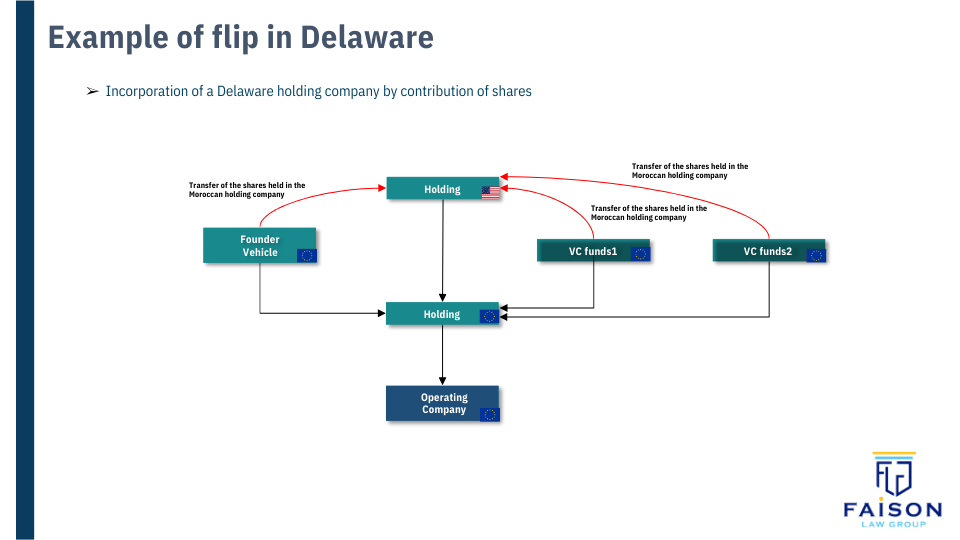
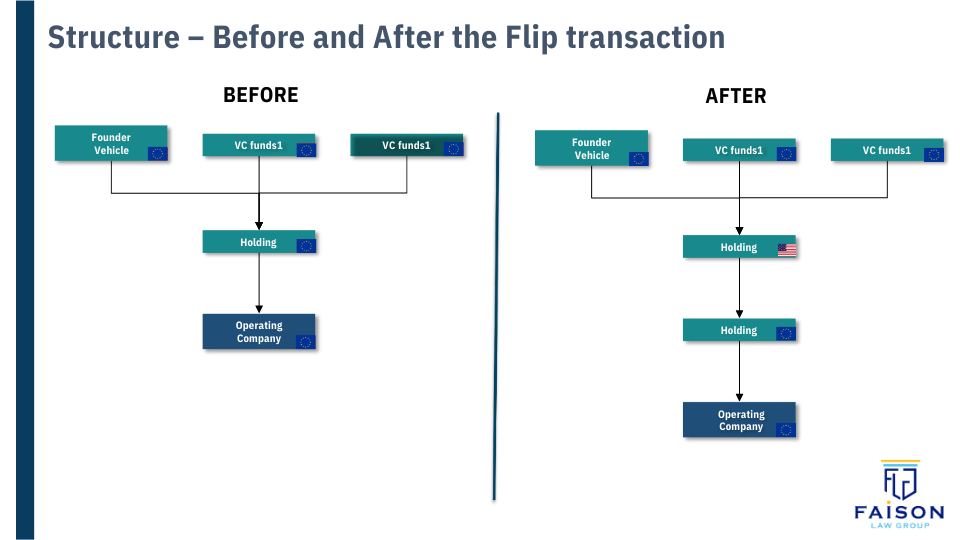
Foreign founders frequently need to “flip” their existing company into a U.S. holding structure when they begin targeting venture capital or U.S.-based acquirers. The mechanics are straightforward in concept but require precision in execution.
How a Delaware Flip Works
A cross-border flip typically involves:
- Forming a new Delaware C-corp that will serve as the parent holding company
- Transferring equity from the original non-U.S. entity into the new Delaware parent
- Addressing existing shareholder rights, including any prior SAFEs, convertible notes, or option grants
- Managing tax consequences in both the home country and the United States
- Cleaning up the cap table so investors see a clear, institutional-grade structure
Typical Use Cases
| Scenario | Why a Delaware Flip Makes Sense |
|---|---|
| European AI or FinTech startup (2024–2026) | U.S. VCs strongly prefer Delaware C-corps for governance, investor rights, and exit predictability |
| Canadian or UK life sciences spinout | Aligning with U.S. pharma partners or preparing for FDA-focused commercialization |
| Latin American founders preparing for U.S. Series A | Removing friction for lead investors who want standard Delaware documents |
Common Pitfalls in Delaware Flips
Foreign companies attempting a flip without experienced guidance often stumble on:
- Ignoring tax implications in the home country (some jurisdictions treat equity transfers as taxable events)
- Failing to clean up prior SAFEs or notes before restructuring, creating ambiguity about conversion terms
- Creating cap table confusion where U.S. and non-U.S. equity don’t reconcile
- Overlooking local corporate law requirements for dissolving or maintaining the original foreign entity
Faison Law Group regularly advises on Delaware formations for globally oriented startups, including coordination with foreign accountants and local counsel. Specific tax structuring requires working with qualified tax advisors, but the firm ensures transactional documents align with your broader international strategy.
Planning a 2025 or 2026 U.S. expansion? Call (667) 213-6640 or message us online to schedule a confidential, informational consultation about whether a Delaware flip may be appropriate for your situation.
Next: Once the company structure is in place, the next challenge is raising capital from international investors.
Raising Capital Internationally: Venture, Angels, and Foreign Investors
Cross-border fundraising for startups often involves a blend of U.S. venture funds, overseas angel investors, family offices, and strategic investors from multiple countries. Our international startup lawyers also advise on private equity investment structures and cross-border transactions, ensuring clients are well-positioned for complex international deals.
Faison Law Group assists clients in identifying capital and strategic partnership opportunities in international markets.

Each investor type may be subject to different legal and regulatory frameworks—and founders bear responsibility for ensuring compliance.
Faison Law Group’s International Business Law attorneys provide guidance for clients to effectively transact international business while minimizing legal and regulatory risk.
Understanding the Regulatory Landscape
When U.S. startups accept capital investment from non-U.S. persons, several regulatory dimensions come into play:
- U.S. private offering rules (such as Regulation D Rule 506(b) and 506(c)) govern how securities may be offered and sold, including limits on general solicitation and requirements for accredited investor verification
- Foreign investors may face additional documentation requirements, including subscription document representations about their status under U.S. securities law
- KYC/AML diligence is essential when onboarding investors from certain jurisdictions
- Beneficial ownership reporting under the Corporate Transparency Act may apply, though certain exemptions exist for foreign entities depending on their structure
For startups in sensitive industries—FinTech, payments, life sciences, AI—foreign investment review regimes like CFIUS may also be relevant. Early identification of these issues prevents surprises that can delay or derail closings.
Practical Issues in Multi-Jurisdiction Rounds
When investor groups span the U.S., Europe, Asia, and the Middle East, founders need consistent documentation:
- Cap tables that reconcile across entities
- Board control provisions that reflect the actual governance structure
- Information rights that comply with both U.S. expectations and foreign data protection rules
- SAFE or convertible note terms that account for currency, jurisdiction, and conversion mechanics
Faison Law Group has extensive experience with early-stage fundraising (Seed to Series A) across borders. The firm reviews SAFE and convertible note structures used with foreign investors, ensures Regulation D compliance, and helps founders understand the unique challenges of accepting capital from abroad.
This article does not provide investment advice, does not describe any specific offering, and makes no representation about fundraising outcomes. All fundraising transactions depend on market conditions, regulatory compliance, and individual investor decisions.
Preparing to onboard foreign investors in 2024–2026? Contact Faison Law Group at (667) 213-6640 or message us online to discuss potential regulatory, corporate, and documentation issues.
Next: After raising capital, startups in FinTech, payments, and AI must address overlapping regulatory and privacy challenges in cross-border operations.
FinTech, Payments, and AI Privacy in Cross-Border Operations
FinTech, payments platforms, and AI-driven products face a unique set of cross-border legal challenges. Our firm has counseled clients on navigating these challenges in FinTech, payments, and AI, providing expert legal advice and strategic guidance on complex international and cross-border legal matters. The entrepreneurial ecosystem in these industries moves fast, but regulations do not always keep pace—or align across jurisdictions. Faison Law Group advises businesses on cross-border transactions and related disputes, helping clients draft agreements and comply with various laws.
Navigating FinTech Regulations
A FinTech company operating across borders may encounter:
| Regulatory Layer | U.S. Requirements | Foreign Requirements |
|---|---|---|
| Money transmission | State-by-state licensing, FinCEN MSB registration | EU PSD2/EMI licensing, UK FCA authorization |
| Consumer protection | CFPB oversight, state consumer laws | Local consumer protection regimes |
| AML/KYC | Bank Secrecy Act, OFAC screening | Country-specific AML frameworks |
| Data privacy | CCPA, state privacy laws | GDPR, UK GDPR, emerging national laws |
Financial institutions and payments startups must map these overlapping requirements carefully. Faison Law Group helps clients understand the regulatory compliance landscape without suggesting any particular structure will achieve compliance in all cases—because every situation depends on specific facts, business models, and jurisdictions.
Addressing AI and Data Privacy Challenges
AI products that process personal data across borders must reconcile U.S. privacy frameworks with foreign regimes like GDPR. Common issues include:
- Designing data processing agreements that satisfy both U.S. and EU requirements
- Implementing Standard Contractual Clauses or relying on the EU-U.S. Data Privacy Framework for transatlantic transfers
- Addressing emerging AI regulations, including the EU AI Act’s tiered risk classifications
How Faison Law Group Supports Technology Clients
The firm helps clients design:
- Transaction documents and terms of service reflecting cross-border data flows
- Vendor and customer contracts with appropriate data protection addenda
- Compliance frameworks that allocate responsibility between parties
Startups working with foreign research partners, manufacturing operations abroad, or customers in controlled jurisdictions should seek qualified legal advice tailored to their specific facts.
Launching in new international markets or signing data-sharing agreements with foreign partners? Call (667) 213-6640 or contact Faison Law Group online to discuss your FinTech, payments, or AI privacy needs.
Next: As your business grows, cross-border mergers and acquisitions become a key consideration for expansion or exit.
Cross-Border Mergers & Acquisitions, Including SBA-Backed Transactions
Cross-border M&A for startups and closely held companies presents distinct legal issues that differ from purely domestic deals. Whether you’re a buyer acquiring overseas assets or a seller with foreign operations, the transaction requires coordinating multiple legal systems, regulatory regimes, and commercial realities. The firm represents clients in cross-border M&A transactions, advocating for their interests across multiple legal systems.
Faison Law Group’s Cross-Border Business Team has developed close working relationships with leading lawyers and professionals from around the globe.

Common Cross-Border M&A Scenarios
- A U.S. software company acquiring a development shop in Eastern Europe or South America
- A foreign buyer acquiring a U.S. target that previously raised venture capital
- An SBA-financed acquisition where intellectual property or operations are located in more than one country
- Exit transactions where the acquirer is a multinational with operations in the Middle East, Europe, or Asia-Pacific
Key Legal Dimensions of Cross-Border Deals
| Issue | Why It Matters |
|---|---|
| Due diligence on foreign subsidiaries | Local corporate records, employment obligations, tax liabilities may differ from U.S. norms |
| IP ownership across jurisdictions | Patents, trademarks, and trade secrets may be registered—or unprotected—in different countries |
| Employee and contractor transitions | Foreign labor laws often provide greater protections than U.S. at-will employment |
| Currency and payment mechanics | Exchange rate risks, repatriation restrictions, and withholding taxes affect deal economics |
| Post-closing integration planning | Harmonizing operations, reporting, and compliance across entities |
Faison Law Group supports buyers and sellers in structuring letters of intent, definitive purchase agreements, and ancillary documents to manage cross-border risks. The firm’s approach keeps transactions implementable and cost effective—without sacrificing the protections sophisticated parties expect.
Every transaction is fact-specific and subject to regulatory review, contractual negotiation, and market conditions. This article does not promise any particular deal outcome.
Considering a cross-border purchase or sale in the next 12–24 months? Call (667) 213-6640 or message us online to request an introductory discussion about potential legal and structural issues.
Next: Beyond transactions, international growth requires a coordinated approach to IP, data, and contracting strategy.
International IP, Data, and Contracting Strategy for Startups
International growth isn’t only about fundraising and mergers. It also requires deliberate planning for intellectual property, data governance, and commercial contracts that work across jurisdictions.
Coordinating IP Strategy Globally
When development teams, customers, or manufacturing partners are located in different countries, IP protection becomes more complex:
- Patents may require filings under the Patent Cooperation Treaty (PCT) to preserve priority across 150+ countries
- Trademarks can be protected through Paris Convention priority filings or Madrid Protocol registrations
- Trade secrets must be protected through NDAs and internal controls that hold up under both U.S. law (Defend Trade Secrets Act) and foreign equivalents
A U.S. AI startup working with a hardware partner in East Asia and a research partner in Europe needs coordinated IP strategy—not piecemeal protection that leaves gaps.
Adapting Commercial Contracts for International Customers
Standard commercial contracts—SaaS agreements, reseller agreements, data processing addenda, and NDAs—often require jurisdiction-specific modifications for customers in the EU, UK, Canada, or the Middle East:
- Governing law and dispute resolution provisions must be enforceable in the relevant jurisdictions
- Data transfer clauses must comply with GDPR and other local privacy requirements
- Limitation of liability and indemnification terms may be unenforceable or require modification in certain countries
- Licensing agreements for software or IP must account for local distribution rules
Faison Law Group assists startups in building scalable, repeatable contract frameworks that can be adapted with local counsel input rather than reinvented for every country. This approach achieves business objectives efficiently while managing legal risks.
Cross-border IP and data issues frequently hinge on detailed factual and technical considerations. This material is educational and cannot substitute for targeted advice from qualified counsel.
Next: Learn how to engage Faison Law Group for your international and cross-border legal needs.
Working With Faison Law Group on International and Cross-Border Matters
Faison Law Group is a boutique transactional law firm offering world-class legal services on a flexible, often fixed-fee basis. The firm represents a broad range of clients—from publicly traded multinationals to small main street businesses—who share one thing in common: they need sophisticated legal counsel for complex transactions without big-firm overhead. The firm also has significant experience in international arbitration, managing arbitration proceedings to resolve disputes with foreign partners.
Who We Represent
The firm’s attorneys advise clients across industries including:
- FinTech and payments companies
- Life sciences and healthcare startups
- AI and software businesses
- Emerging funds and fund managers
- Buyers and sellers in SBA-financed acquisitions
- Foreign founders entering U.S. markets
Our Approach to Cross-Border Work
Faison Law Group’s legal team takes a practical, business-focused approach to international matters:
- Clear timelines so founders know what to expect at each stage
- Early identification of cross-border regulatory touchpoints to avoid surprises
- Coordination with foreign counsel where local expertise is required
- Cost-conscious structuring that achieves legal protection without unnecessary complexity
Engagement Process
Working with Faison Law Group begins with an initial consultation to understand your business, your goals, and the cross-border dimensions of your situation. The firm conducts conflict checks and, if appropriate, provides an engagement letter outlining scope, fees, and responsibilities. No attorney-client relationship is formed until a formal engagement is confirmed.
Ready to explore whether Faison Law Group is the right fit for your international startup needs? Call (667) 213-6640 or message us online. Our team is here to provide clients with thoughtful, compliance-conscious guidance on the legal challenges facing companies operating in international markets.
Disclaimer
This article is for informational purposes only and does not constitute legal advice, investment advice, or an offer or solicitation to buy or sell securities. Reading this content does not create an attorney-client relationship with Faison Law Group. Securities laws, cross-border regulations, and tax rules are complex, fact-specific, and subject to change. Outcomes depend on individual circumstances and regulatory interpretation. Founders, operators, and investors should consult qualified legal and tax counsel about their specific situations before taking action.